.svg)

Android App Development in Riyadh: A Complete Guide for Startups & Enterprises
In this environment, Android app development for your Saudi business is no longer optional; it is a strategic requirement. Android powers the majority of smartphones in Saudi Arabia.
However, app projects now face strict compliance rules, higher user expectations, and tight platform policies. Thus, most founders struggle to choose technologies, platforms, and dev teams.
This guide explains how Android app development works in Riyadh in 2026. We will talk about process, costs, compliance, and real Saudi market needs.
TL;DR
Here’s what you must know about Android app development:
- Android holds around 76% market share in Saudi Arabia
- Best for: eCommerce, food delivery, ride-hailing, logistics, workforce tools, cost-conscious projects
- Cost range: From $30K for MVPs, and up to $200K+ for enterprise apps
- Timelines: 1-3 months for basic ones, up to 12+ months for complex ones.
- 2026 must-haves: Jetpack Compose, full Arabic + RTL support, offline-first, PDPL compliance
- Key challenges: Google Play policies, Target SDK upgrades, device diversity testing
How We Conducted Our Research
We based this guide on first-hand analysis of Android app development projects.
Step 1: Project Selection
We analyzed 20+ Android applications delivered between 2024 and 2026. We had direct development or technical ownership in our team and industry professionals with whom we conducted research.
Step 2: Data Capture
For each project, we logged:
- Scope size (features)
- Team size
- Delivery timeline
- Architecture type
- Device and OS coverage
- Google Play review outcomes
Step 3: Validation
We validated platform and compliance findings through live Google Play Console submissions and PDPL implementations, excluding non-repeatable edge cases.
Finally, senior Android engineers reviewed all inputs to ensure the findings reflect the practical, Saudi-specific Android apps market.
Why Android Apps Matter in 2026
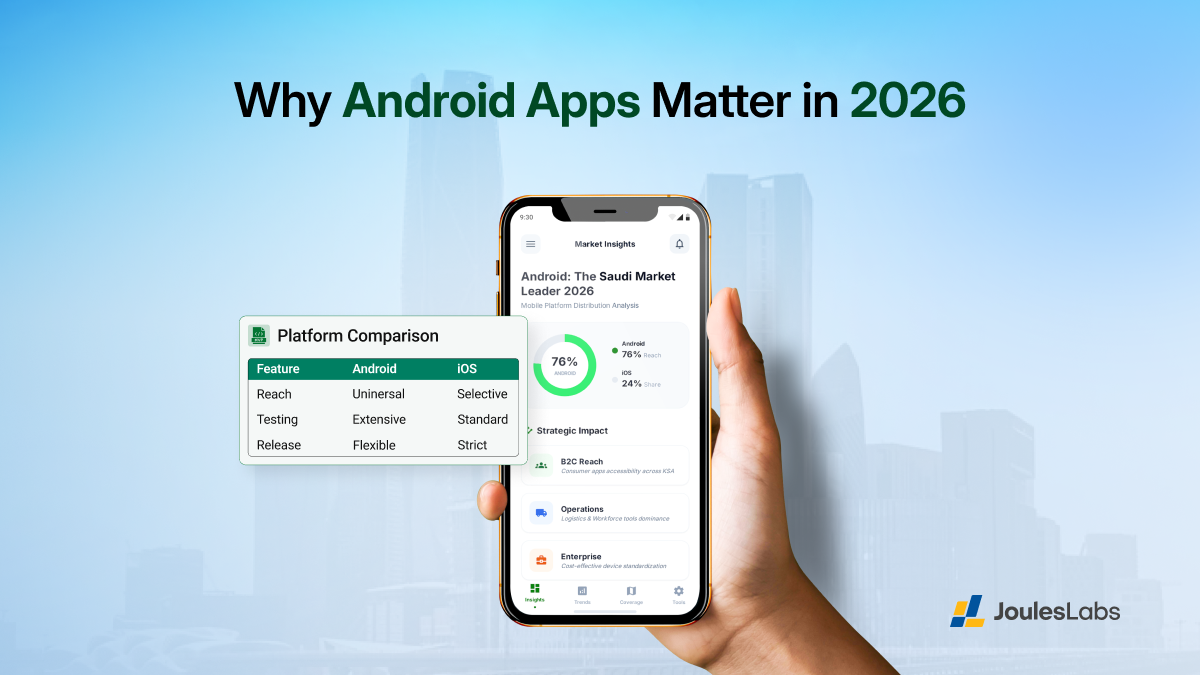
Well, the importance of Android apps is based on usage patterns, device diversity, and enterprise adoption. They directly affect cost, architecture, testing, and long-term maintainability.
Android’s Reach and Device Diversity in Saudi Arabia
Today Android holds about 76% of mobile operating share in Saudi Arabia. This means most local users rely on Android devices daily.
For businesses, this means:
- Faster market reach for B2C applications
- Practical deployment for internal and workforce tools
- Broader accessibility across income levels
When Android-first is the Right Strategy
An Android-first approach makes sense in several Riyadh-based scenarios:
- Consumer platforms such as eCommerce, delivery, booking, or loyalty apps that need broad reach quickly
- Operations and logistics apps used by drivers, field agents, or warehouse teams
- Enterprise and internal tools where device standardization and cost control matter
Android also performs well in regulated environments when security and compliance are designed correctly from the start.
Android vs iOS in Saudi Arabia
Android often means lower entry cost and wider device testing scope. iOS users may spend more, but Android installs usually outnumber them.
Release processes differ between Google Play and the App Store. Testing requirements for Android span many OEMs, which affects timelines.
Android App Development Cost in Saudi Arabia
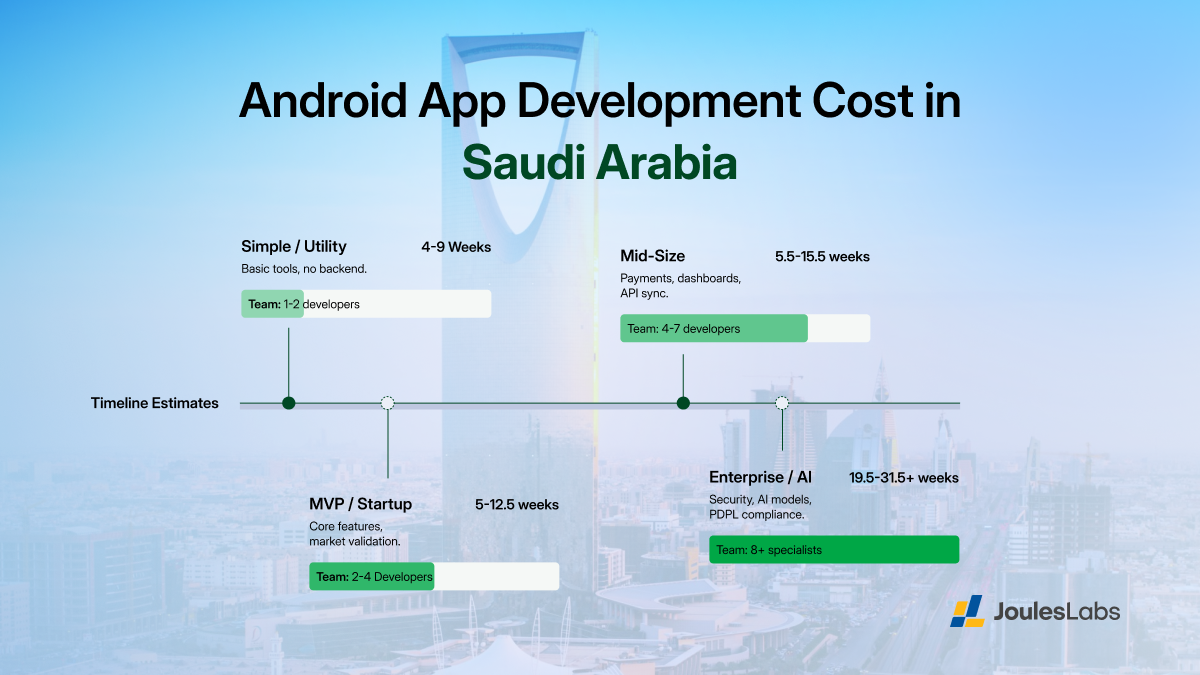
Android app development costs in Riyadh vary significantly. The variation is not arbitrary; it reflects differences in scope, risk, and long-term expectations.
Typical Cost Ranges by Complexity
Basic Android apps typically cost $30,000 – $60,000, while mid-complexity apps range between $60,000 – $120,000. Complex and enterprise apps often exceed $120,000 – $200,000+ due to security and scalability needs.
Major cost drivers include integrations, custom UX/UI, backend systems, device testing, and compliance requirements. Before diving into dev, keep 15-25% budget annually for maintenance, infrastructure, and ongoing platform upgrades.
Want a detailed breakdown? Check out our mobile app development cost guide!
Timelines: How Long Android Development Takes in Saudi Arabia
Timelines often slip not because of technical difficulty, but because of unclear assumptions.
Typical Timelines by Project Size
These timelines assume clear scope, timely feedback, and early compliance planning.
What slows projects down
Common causes of delay include:
- Unclear or expanding scope
- Late UX or design changes
- Complex third-party integrations
- Compliance reviews and procurement cycles
- Google Play policy feedback loops
Teams that address these risks during discovery move significantly faster during delivery.
The Complete Android App Development Process
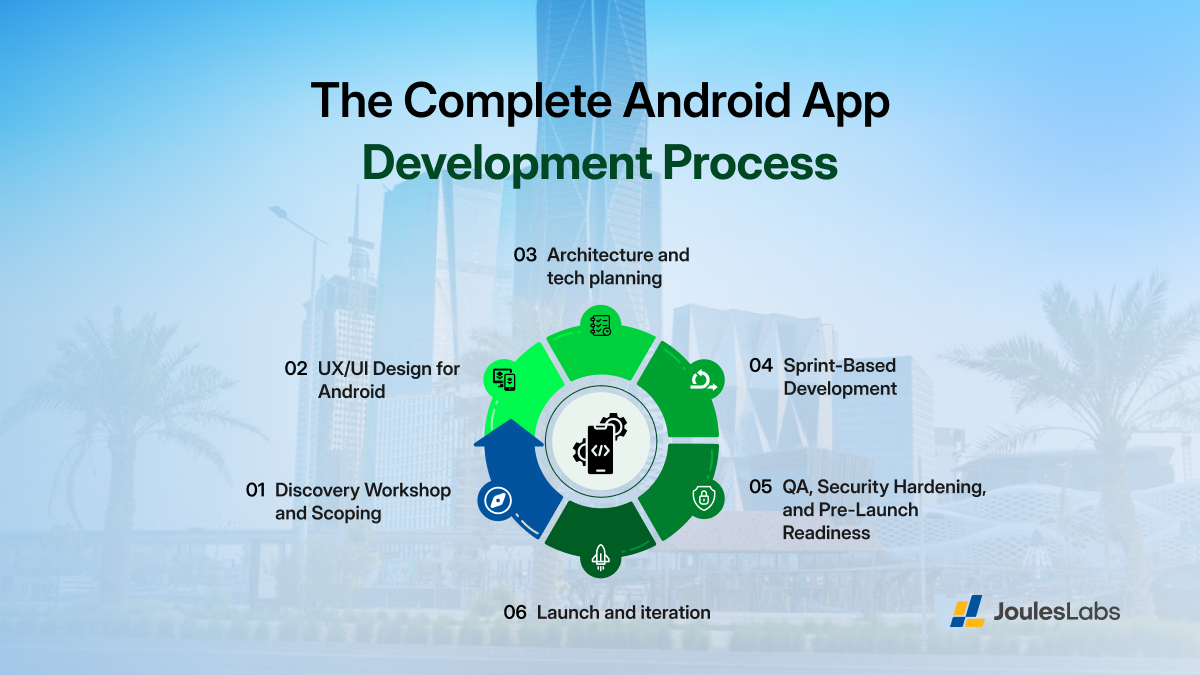
A successful Android app doesn’t happen by accident. It’s the result of many small, smart decisions made in the right order.
In Saudi Arabia, the teams that win follow a clear process but stay flexible. Let me walk you through how it really works and how we handle it.
Step 1: Discovery workshop and scoping
Before a single line of code, you’ll sit with your team and answer the core questions that will shape how the app will turn out.
Here are some common questions you’ll have to answer:
- Who exactly is the user?
- What problem are they trying to solve on a normal day?
- And how will we know the app is working?
Clear KPIs matter here. Not vanity metrics, but real signals. Retention, task completion, or operational efficiency usually matter more than downloads.
One decision makes or breaks timelines. Where does the MVP stop, and where does V1 begin? Without that boundary, feature bloat sneaks in quietly.
Suddenly timelines slip, budgets stretch, and focus disappears. By the end of discovery, teams usually lock in:
- A clear PRD everyone agrees on
- A prioritized backlog
- A high-level architecture sketch
- A simple risk register covering tech and delivery
Step 2: UX/UI design for Android (and Arabic/RTL readiness)
Design starts intentionally simple. Early wireframes validate user flows without emotional attachment. Clickable prototypes then let stakeholders experience the app early.
Feedback shapes the final UI, not assumptions. Android design follows its own language. Material You helps apps feel native and familiar immediately.
Localization is planned early for Saudi users. Arabic and English layouts behave differently. RTL impacts navigation, spacing, and component alignment.
Step 3: Architecture and tech planning
Good architecture keeps apps fast, flexible, and scalable. It’s best to plan modular structures from the start. Features remain independent, making updates safer and faster.
Offline behavior matters for logistics or field-based apps. Core workflows must survive poor connectivity. Clear data sync rules prevent loss and conflicts.
Analytics planning also happens here. Teams define key events, funnels, and cohorts early. Without this, post-launch decisions rely on guesswork.
Step 4: Sprint-based development
Development happens in short, focused sprints. Usually two weeks at a time. Each sprint includes planning, development, and review.
Regular demos keep everyone aligned and accountable. Quality assurance runs alongside development, not at the end. This reduces last-minute surprises and unstable releases.
Automation supports speed and consistency:
- CI pipelines for Android builds
- Automated testing where possible
- Faster internal releases for feedback
This rhythm keeps momentum strong.
Step 5: QA, security hardening, and pre-launch readiness
Before launch, stability becomes the priority. Android device diversity makes this step non-negotiable.
Testing covers multiple screen sizes, OS versions, and manufacturers. Regression testing ensures new changes don’t break old flows.
Performance matters more than many teams expect. Slow startup times, choppy scrolling, or battery drain frustrate users quickly.
Security reviews validate authentication, encryption, and secrets handling. For enterprise and regulated apps, this step is critical.
Step 6: Launch and iteration
Launch is not the finish line. It’s where learning really begins. Teams often start with closed testing and staged rollouts. This reduces risk and allows quick fixes.
Monitoring dashboards track crashes, performance, and engagement. Real user behavior guides the next set of decisions.
Post-launch work focuses on improvement. Retention, conversion, and experience get refined over time. The best Android apps evolve continuously, not once.
Recommended Tech Stack for Android Apps in 2026
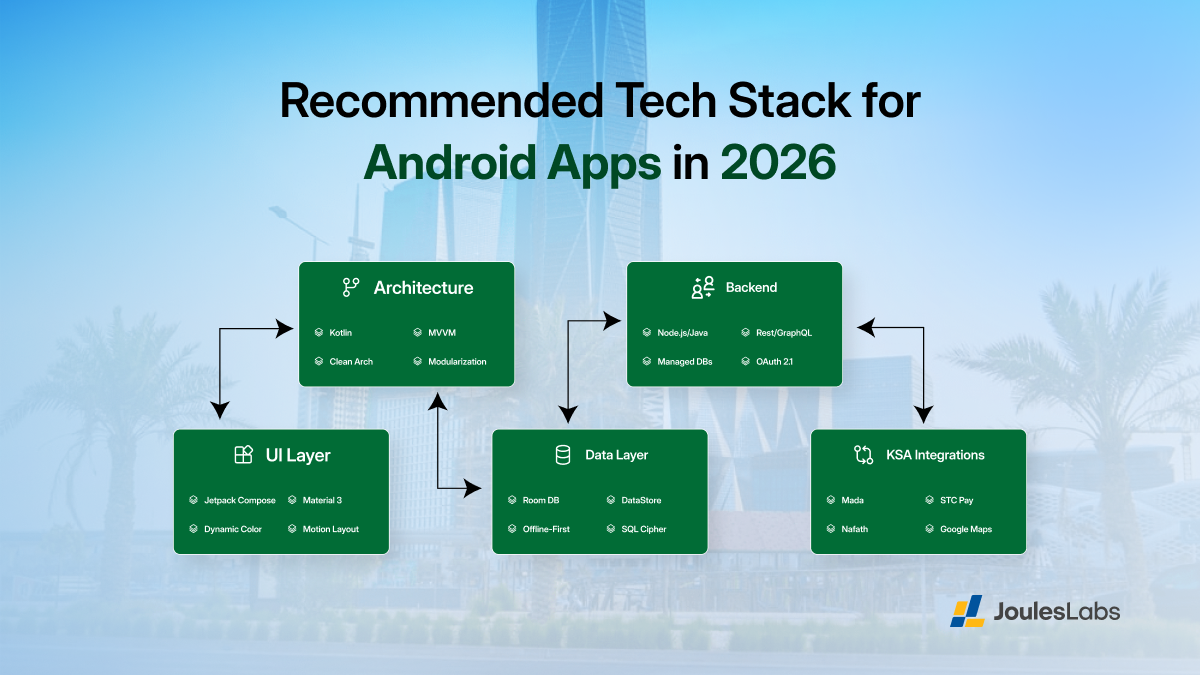
Choosing the right tech stack matters more than ever in 2026. Poor choices slow delivery and limit future growth. The right stack keeps apps scalable, maintainable, and easier to evolve.
UI layer: Jetpack Compose for modern Android
Google has made its direction clear. Jetpack Compose is the recommended modern UI toolkit for Android. Compose removes XML-heavy layouts and simplifies UI development.
Interfaces become more declarative, readable, and easier to test. Teams also ship faster once they gain experience with it. Compose works best when:
- Building new Android apps from scratch
- Designing dynamic, state-driven interfaces
- Prioritizing long-term maintainability
Legacy Views still exist. Older apps or highly customized components may rely on them. Many teams mix Compose and Views during gradual migrations.
App architecture patterns that scale
As Android apps grow, structure becomes essential. Most scalable projects use MVVM with Clean Architecture:
- UI handles presentation
- Business logic remains isolated
- Data flow stays predictable
This separation improves testability and onboarding while reducing accidental breakage. Modularization reinforces these benefits.
Feature modules keep codebases manageable. Core modules handle shared concerns like networking and authentication, enabling parallel development.
Over-engineering should be avoided. Architecture should scale with real complexity, not anticipated complexity.
Data layer and offline-first
Data reliability shapes user perception more than visual polish. Room is commonly used for structured local storage.
DataStore replaces SharedPreferences for cleaner and safer state management. Caching strategies minimize unnecessary network calls.
For logistics and workforce apps, offline-first behavior is essential. Sync mechanisms handle retries, conflict resolution, and background updates without disrupting users.
Backend options commonly used with Riyadh projects
Backend choices often reflect team expertise and ecosystem alignment. Node.js, Java, and .NET are widely used in Riyadh-based projects.
APIs are typically exposed via REST or GraphQL. Managed databases reduce operational overhead and simplify scaling.
An admin panel is rarely optional; operations teams need visibility into users, transactions, and workflows to run efficiently.
Third-party integrations typical in Saudi apps
Most Saudi Android apps rely on multiple integrations:
- OTP and SMS providers for authentication
- Mapping services for delivery and logistics
- Analytics platforms for product decisions
- Payment gateways aligned with local regulations
- ERP and CRM systems for enterprise workflows
Each integration introduces dependencies. Planning them early prevents timeline surprises.
Google Play publishing and Policy Requirements (must-know in 2026)
.png)
Publishing on Google Play looks simple from the outside. In reality, policies shape how Android apps are built and maintained. Don’t ignore them early, it often leads to delays, rejections, or rushed fixes.
Target SDK requirements and why they affect planning
Google Play enforces strict Target SDK deadlines. From August 31, 2025, apps must target Android 15 (API level 35) to remain compliant.
Target SDK upgrades are not one-time tasks. Each Android release introduces:
- Dependency updates
- API behavior changes
- Retesting across supported devices
These upgrades must be planned as part of yearly maintenance cycles. Treating them as “minor updates” often leads to last-minute compliance pressure.
Data Safety disclosures and privacy alignment
Google Play closely reviews how apps handle user data. The Data Safety section must accurately reflect real behavior.
This includes data collection, sharing, storage, and protection practices. What matters most is consistency. Your Play listing must match your in-app behavior and privacy policy.
Practical steps teams usually take:
- Inventory all SDKs and third-party services
- Map what data is collected and why
- Document retention periods and access controls
If disclosures feel vague or misleading, rejections follow. Play reviews here are stricter every year.
App signing and release integrity
Most teams use Play App Signing, where Google manages signing keys and protects release integrity. Android App Bundles (AAB) have replaced APKs.
AABs enable optimized delivery, smaller downloads, and better device targeting. Release pipelines must be configured early to avoid launch-day surprises.
Anti-abuse and fraud protection
Fraud prevention matters more as apps grow. Google encourages use of the Play Integrity API. This API helps verify:
- Genuine devices
- Untampered app instances
- Trusted runtime environments
It’s most effective around sensitive flows. Login, payments, promotions, and reward systems benefit most. Apply it selectively to avoid unnecessary friction.
Compliance and security for Android apps
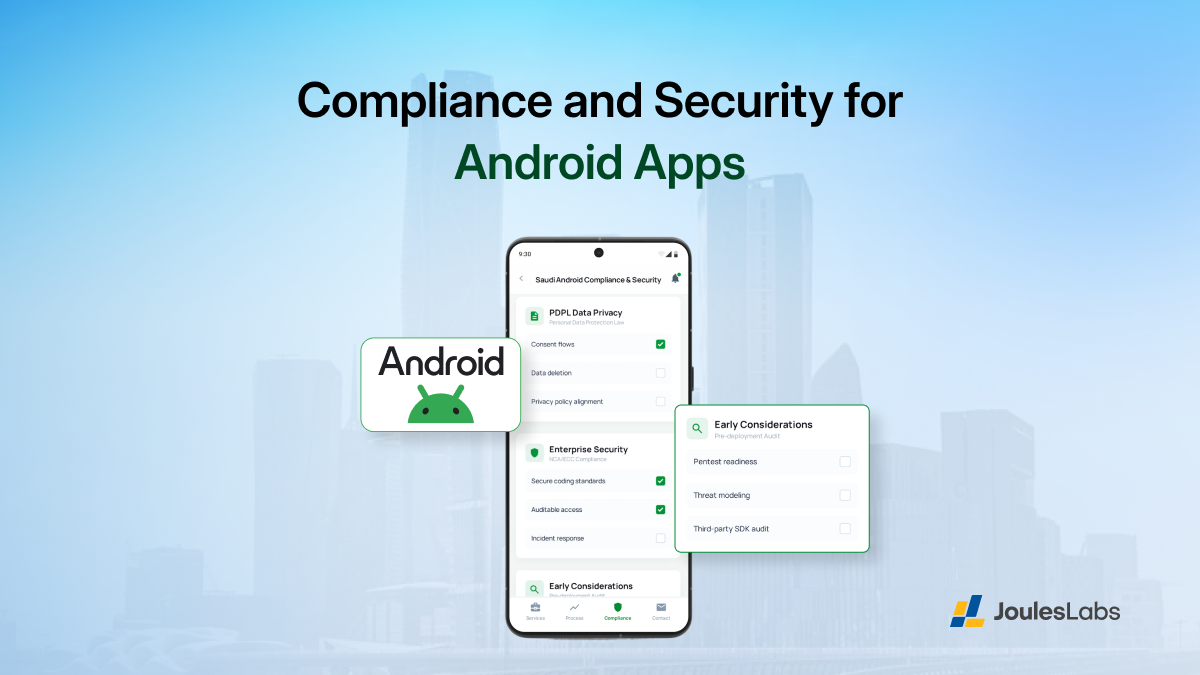
Compliance in Saudi Arabia now shapes Android apps from day one. It directly affects UX, architecture, and delivery timelines.
PDPL practical considerations for mobile apps
Saudi Arabia’s Personal Data Protection Law (PDPL) is enforceable and directly impacts mobile applications.
Android apps must:
- Collect data for clear, documented purposes
- Use explicit and understandable consent flows
- Provide access, correction, and deletion mechanisms
Privacy policies must reflect real app behavior. Bundled or unclear consent introduces compliance risk. Third-party SDKs must align with PDPL through vendor contracts.
Cybersecurity expectations for enterprise/government work
Enterprise and government projects typically follow the National Cybersecurity Authority’s Essential Cybersecurity Controls (ECC).
ECC affects processes, not just tools:
- Secure development practices are expected
- Access controls must be auditable
- Logging and monitoring should support investigations
- Incident response readiness is required
These expectations increase scope but reduce long-term risk.
What to bake into scope early
Security should be planned, not added later. Teams should scope security testing and pentest readiness.
Threat modeling matters for fintech and healthcare apps. Secure authentication and token storage are non-negotiable.
How to Choose the Right Android App Development Company in Riyadh
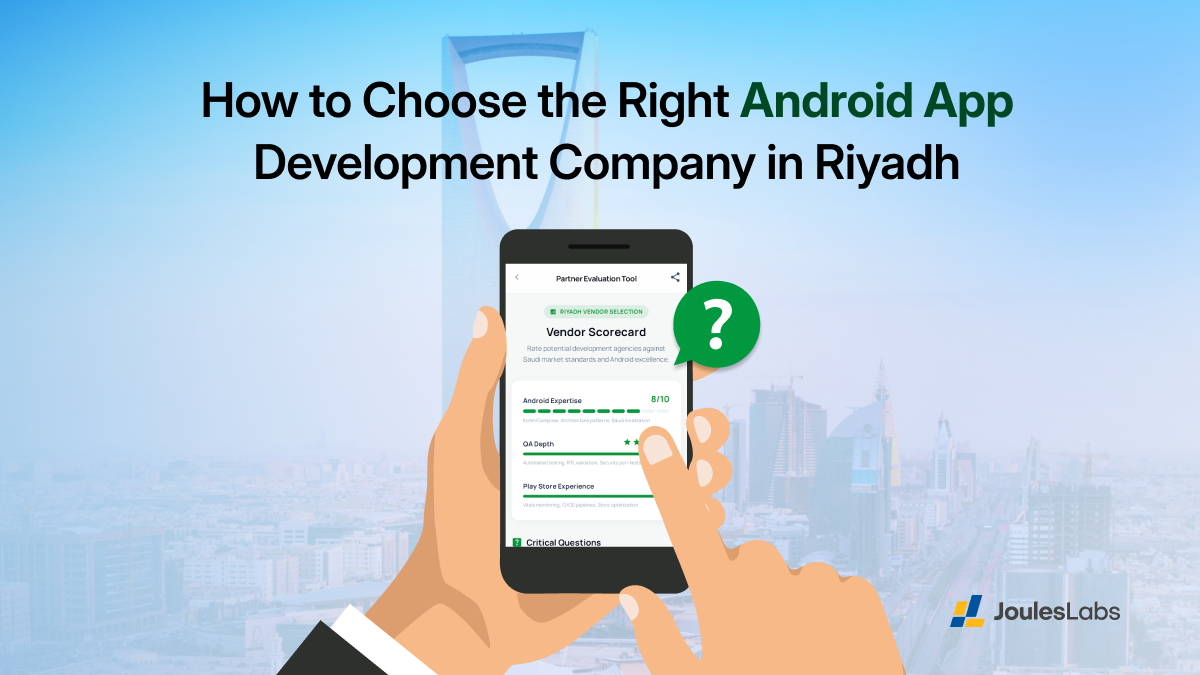
The right mobile app developers reduces risk long after launch. Not every mobile agency understands modern Android delivery.
What to Look For in an Android-Focused Partner
Strong partners demonstrate:
- A proven Android-specific portfolio
- Jetpack Compose and modern toolkit experience
- Play Store release and policy maturity
- Clear QA strategy and device coverage
- Defined post-launch support and monitoring
Questions to Ask During Discovery
Key questions include:
- How is MVP scope defined and controlled?
- How are Arabic and RTL layouts tested?
- What is the Play Console release and review process?
- How are security and PDPL requirements handled in practice?
Clear answers signal maturity.
Red Flags in Proposals
Warning signs include:
- No discovery phase
- Weak or missing QA plans
- Vague “support included” statements
- No mention of Play policies, Target SDKs, or Data Safety
These often lead to delivery issues later.
Post-Launch: Maintenance, Updates, and Scaling
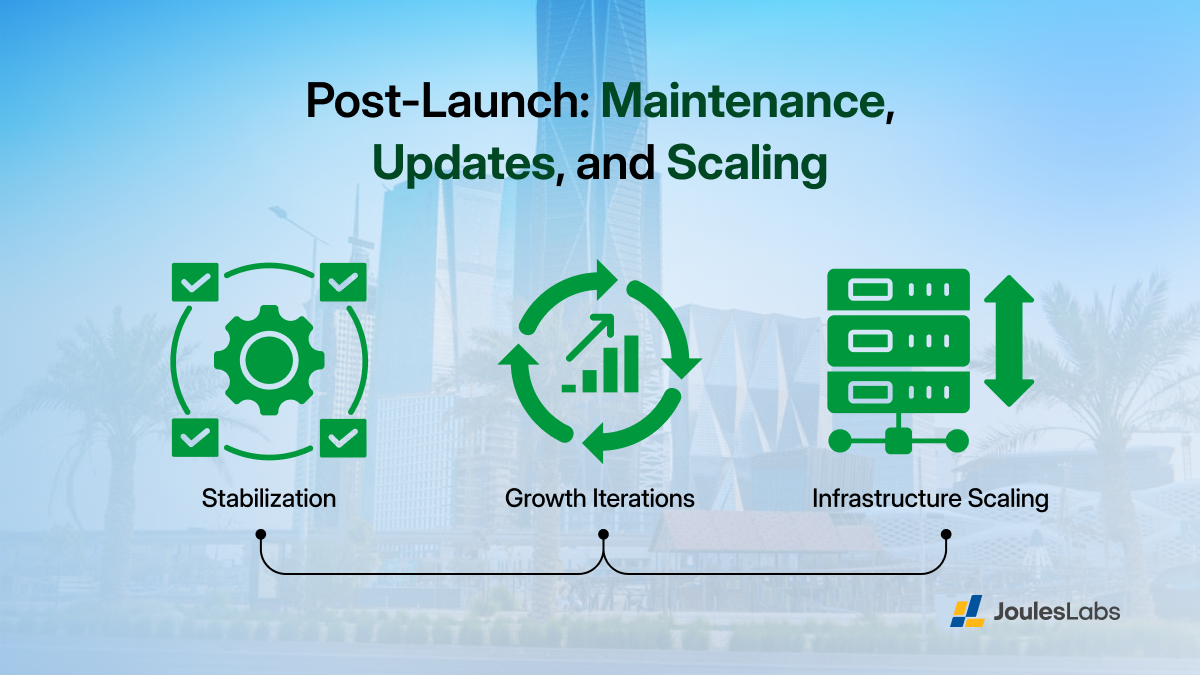
Launching the app is only the beginning, not the finish line. Real cost and value show up after users start using it.
What Maintenance Actually Includes
Android maintenance ensures stability and compliance:
- Target SDK upgrades
- Security patches and dependency updates
- Bug fixes and performance tuning
- Monitoring and incident response
Growth Roadmap for the First 90 Days
A phased approach keeps teams focused:
- Weeks 1-2: Stabilization and crash reduction
- Weeks 3-6: Conversion improvements (onboarding, checkout)
- Weeks 7-12: Retention through personalization and notifications
Infrastructure Scaling Basics
As usage grows:
- Media storage and CDNs improve load times
- Caching and database scaling prevent bottlenecks
- Monitoring detects issues before users notice
FAQs
What’s the difference between native Android and cross-platform?
Native Android offers better performance and control, while cross-platform reduces cost by sharing code across Android and iOS.
Is Jetpack Compose the best choice for new Android apps?
Yes, Jetpack Compose is Google’s recommended modern toolkit for new Android apps, offering faster development and easier long-term maintenance.
What is the Data Safety section and how do we fill it correctly?
It describes data collection, sharing, and protection practices. It must match your app’s behavior, SDK usage, and published privacy policy.
Do Riyadh apps need Arabic and RTL support from day one?
Yes, supporting Arabic and RTL early improves usability, trust, and adoption in Saudi Arabia.
What security measures should enterprise Android apps include?
Secure authentication, encrypted storage, protected APIs, logging, monitoring, and integrity checks for high-risk actions are essential.\
What should be included in post-launch support?
Target SDK updates, security patches, bug fixes, performance monitoring, crash reduction, and incremental feature improvements.
How do I compare quotes from mobile development companies in Riyadh?
Compare scope clarity, QA coverage, Play policy experience, security approach, timelines, and post-launch support; not just price.
What are the biggest reasons Android apps get delayed before launch?
Unclear scope, late design changes, compliance reviews, Play policy issues, insufficient testing, and unplanned Target SDK upgrades.
Parting Advice
Android app development in Saudi is mature, competitive, and opportunity-rich. Success comes from combining strong technical choices with local market awareness.
From planning and compliance to launch and scaling, details matter at every stage. Teams that invest early in architecture, UX, and security move faster later.
Whether you are a startup or enterprise, clarity beats speed. Build thoughtfully, partner wisely, and treat Android apps as long-term products; not one-time projects.