.svg)

iOS App Development in Saudi Arabia: Cost, Process, and Best Practices
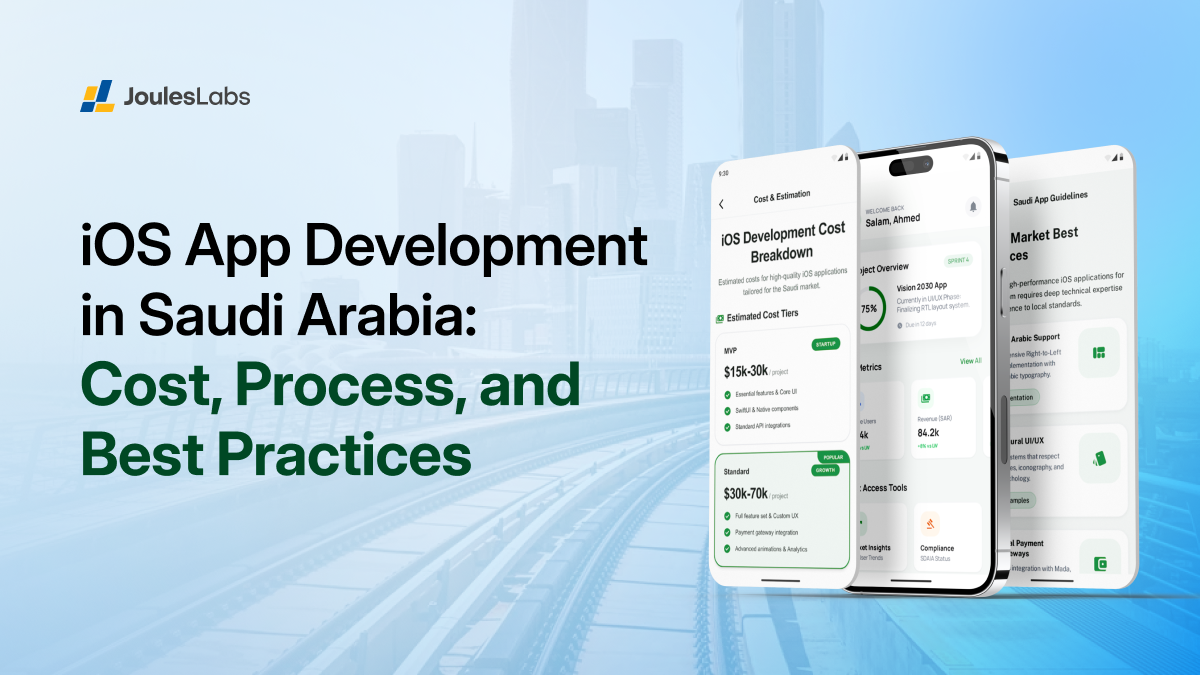
iOS app development is booming in Saudi Arabia, and for good reason. Over 40% smartphone users are daily driving iOS with a growing market share.
In 2024, Saudi Arabia’s mobile app market generated about $1.34 billion. And it’s set to hit $2.38 billion by 2030, Apple App Store being the largest contributor.
But building an iOS mobile app isn’t about writing code only. It needs proper research, great UX, a rock-solid backend, QA, compliance, security, and a growth strategy.
Let’s break down the process, costs, development steps, timelines, and best practices that fit the Saudi market.
How We Conducted Our Research
We based this guide on structured analysis of 20+ iOS app projects delivered in between 2023 and 2026 across fintech, retail, healthcare, logistics, education, and enterprise sectors.
Step 1: Project Cost Mapping
We reviewed total project budgets, feature scope, development hours, architecture decisions, QA allocation, and post-launch maintenance costs to identify consistent pricing patterns.
Step 2: Platform-Specific Evaluation
We analyzed Apple ecosystem requirements including App Store review cycles, iOS version fragmentation, security standards, Apple Pay integration effort, and compliance constraints affecting timelines.
Step 3: Market Benchmarking
We compared Saudi-based, regional, and offshore iOS developer rates and validated ongoing costs using real hosting, API, analytics, and support pricing data.
Our senior iOS engineers and solution architects reviewed all findings to ensure Saudi-market accuracy and practical relevance.
Why iOS is a high-impact platform for Saudi businesses
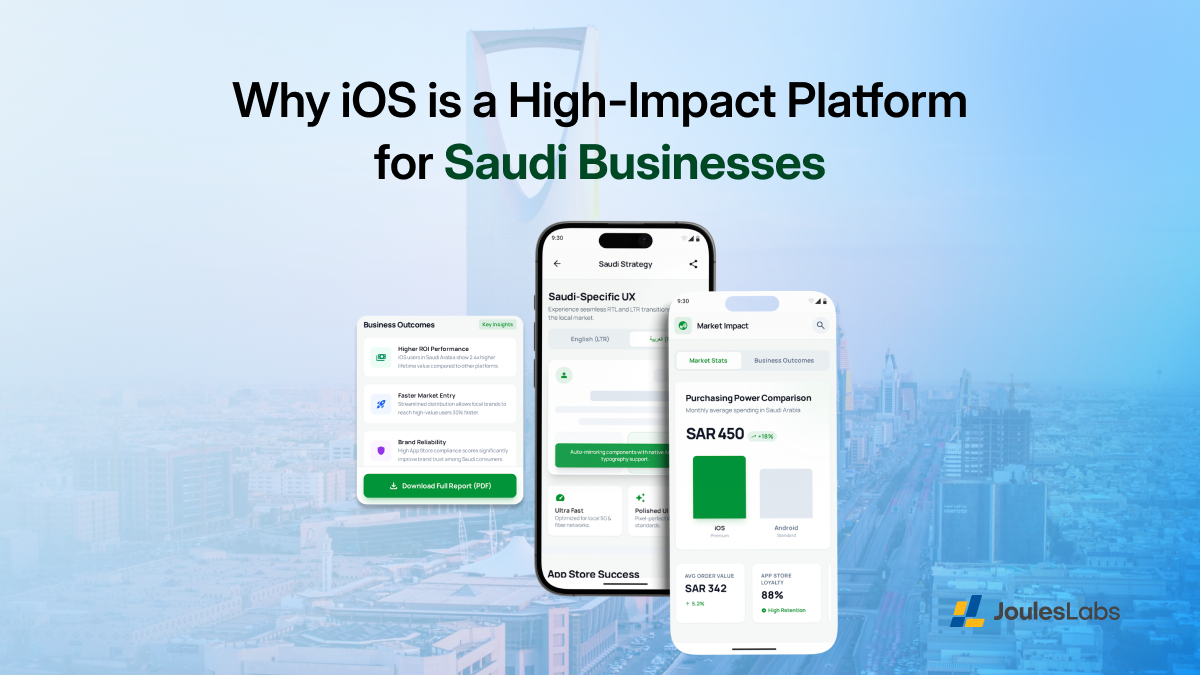
iOS remains a high-impact platform for mobile app development in Saudi Arabia. Apple users are the most loyal to iOS, and here are a few good reasons to create apps for them:
Higher Revenue Per User
Globally, iOS users generate significantly higher in-app revenue compared to Android users, and Saudi Arabia follows a similar pattern in premium sectors such as fintech, luxury retail, subscription services, and digital education.
iOS users tend to:
- Complete purchases more frequently
- Trust in-app payments
- Adopt subscriptions faster
For businesses focused on monetization efficiency rather than sheer volume, this matters.
Strong Ecosystem Integration
Apple’s tightly controlled ecosystem; including Apple Pay, Face ID, iCloud, and device-level security creates smoother, more secure user experiences.
For example:
- Apple Pay reduces checkout friction
- Face ID accelerates secure login
- Native push notifications improve engagement reliability
Such integration often provides higher conversion rates and better retention performance.
Premium User Expectations Drive Higher Quality Standards
iOS users expect speed, stability, and polished UI design. While this increases development discipline, it also elevates brand perception.
Apps that meet Apple’s design and performance guidelines often see:
- Fewer crashes
- Better App Store ratings
- Higher long-term retention
Faster OS Adoption and Update Cycles
iOS users update their devices faster than most Android users. This means:
- Developers can support fewer legacy versions
- Security patches deploy quickly
- New features can roll out without fragmentation concerns
Reduced fragmentation lowers long-term maintenance overhead.
iOS app development cost in Saudi Arabia (2026 ranges)
.png)
Let’s set expectations clearly by scope, quality, and risk for the real iOS app development cost in Saudi Arabia. Most cost surprises happen when teams underestimate discovery, UX, and post-launch work.
Typical Cost Ranges in Saudi Arabia
Saudi market benchmarks commonly place iOS projects between SAR 58,500 and SAR 1,170,000. Local app development companies in Saudi Arabia price based on complexity and timelines.
Each range includes discovery, UI/UX, iOS development, backend, QA, and App Store release. Enterprise projects often involve larger development teams and extended QA cycles.
What Increases iOS Costs Specifically
Custom animations and advanced SwiftUI polish raise both design and testing effort. Apple native features increase scope and require deeper platform-specific expertise.
Examples include Apple Pay, Live Activities, Widgets, Keychain, and HealthKit. App Store review standards also drive higher QA expectations than many Android projects.
Pricing by Engagement Model
Fixed-price models work best when scope and features are clearly defined. Time-and-material suits evolving products or uncertain feature roadmaps.
Dedicated teams fit long-term products needing continuous iteration and scaling. Most mobile app development companies in Riyadh offer all three options.
Ongoing Costs Many Founders Forget
Apple Developer Program fees apply annually for standard and enterprise accounts. Infrastructure costs include hosting, databases, storage, monitoring, and backups.
Third-party APIs like SMS, maps, or analytics add recurring monthly expenses. Maintenance and iOS updates are required to keep your app performing smoothly.
Cost breakdown by phase (how agencies quote iOS projects)
.png)
Most iOS app development companies in Saudi Arabia using structured governance don’t quote randomly. They break work into phases using strict lifecycle overhead multipliers and fixed-hour allocations to control risk, timelines, and quality.
Discovery and Product Planning
This phase aligns business goals with technical reality. Teams define scope before expensive design or development begins.
Typical deliverables include PRDs, user flows, backlogs, risk lists, and architectures. If insufficient clarity exists, a structured Discovery Phase strictly requires 40 – 80 hours prior to formal estimation
UI/UX Design
Design moves from wireframes to clickable prototypes, then polished interfaces. Most agencies build a reusable UI kit or design system.
Arabic language support and RTL layouts are planned at this stage. UI/UX design strictly requires a 30% allocation within the Lifecycle Overhead (Total Engineering Hours × 1.75).
iOS Development + Backend Development
This is the largest and most resource-heavy phase. It includes iOS app logic, APIs, databases, and admin dashboards. Custom mobile app features and integrations drive effort here.
Development is strictly calculated using Feature Complexity Modeling: Basic (20 hrs), Medium (50 hrs), and Advanced (120 hrs).
Backend complexity (+15-25%), Admin Panels (+10-30%), and Mobile API Expansion (+10-40%) are added as fixed percentage adjustments to these core hours
QA + Stabilization + Performance Checks
Testing ensures the app runs smoothly across devices and iOS versions. Teams handle regression testing, crash reduction, and performance tuning. Quality Assurance strictly requires a 30% allocation within the Lifecycle Overhead
App Store Release + Post-Launch Iteration
Agencies prepare store listings, screenshots, TestFlight builds, and rollout plans. Post-launch monitoring and quick fixes reduce App Store rejection risks.
- Project Management receives a strict 15% allocation in the lifecycle multiplier.
- DevOps and Infrastructure requires a fixed addition of ~40 hours (Basic), ~80 hours (Standard), or 120-150 hours (Enterprise) depending on the tier.
- Post-Launch Maintenance is strictly set at ≈ 18% of the Final Delivery Cost annually
Phase-by-Phase Budget Allocation
iOS app development process in Saudi Arabia (step-by-step)
.png)
A professional iOS app development process builds trust before a single feature ships. In Saudi Arabia, buyers expect structure, transparency, and predictable delivery.
Here’s how leading iOS app development companies in Saudi Arabia typically work:
Step 1: Discovery Workshop and Validation
Everything starts with clarity, not code. Teams define target users, jobs-to-be-done, success KPIs, and MVP scope.
Business goals are mapped directly to product features early. Risk areas are identified before development begins.
Common risks include third-party integrations, data handling, compliance, and performance constraints. This step prevents costly rework later in the development process.
Step 2: UX Architecture and Prototyping
Next, teams design how users move through the app. User journeys and information architecture are mapped in detail. Clickable prototypes validate flows before UI design starts.
Early validation helps align stakeholders and reduce usability risks. Saudi-specific expectations like Arabic language and RTL layouts are considered here.
Step 3: Technical Architecture Planning
This step defines how the app is built, not just what it does. Teams decide between SwiftUI and UIKit based on scope and longevity.
Backend architecture, database models, and admin panel needs are finalized. Scalability and security are planned from day one.
Analytics plans are also defined early. Events, funnels, and KPIs are tracked from the first release.
Step 4: Sprint-Based Development
Development runs in short, structured sprints. Each sprint delivers testable features and visible progress. Regular demos keep stakeholders aligned and informed.
Backlog grooming allows priorities to evolve without derailing timelines. Iterative releases reduce risk and improve overall product quality.
Step 5: QA, Security Hardening, and App Store Readiness
Testing goes beyond basic functionality. Teams focus on regression testing, performance, and crash reduction. Apple privacy requirements are carefully implemented.
Permission flows and data disclosures must be accurate. If accounts exist, Apple requires in-app account deletion support.
Step 6: Release, Measure, Improve
Launch is treated as the beginning, not the finish line. Phased rollouts reduce risk across Saudi Arabia’s user base.
Crash monitoring and performance metrics guide quick improvements. Conversion optimization helps the app perform at its best over time.
Best practices for building high-performing iOS apps (Saudi-ready)
.png)
This is where serious iOS products separate themselves from generic builds. Robust iOS mobile apps demand modern engineering, security discipline, and Saudi-specific UX thinking.
Use Modern iOS Engineering Standards
Start with a Swift-first development approach. Swift offers better safety, performance, and long-term maintainability than legacy alternatives.
Use SwiftUI where it fits naturally, especially for modern, reusable interfaces. Rely on UIKit for complex navigation or highly customized components.
Most professional teams follow Clean Architecture or MVVM patterns. For buyers, this simply means clearer code separation and easier future updates.
Performance Best Practices
Performance directly impacts retention and App Store ratings. Optimize app startup time by deferring non-critical tasks.
Implement efficient image loading with proper caching strategies. Use offline-first logic for critical flows like checkout or form submission.
Add crash reporting and performance monitoring from day one. This observability ensures your app keeps performing at its best.
Security and Privacy by Design
Security cannot be an afterthought in Saudi Arabia. Minimize data collection to only what’s truly required.
Encrypt sensitive data both at rest and in transit. Use secure authentication with proper token storage and Keychain usage.
Fintech and healthcare apps should be penetration-test ready from launch. For regulated and enterprise procurement, security controls are often mandatory.
Saudi organizations commonly reference National Cybersecurity Authority guidelines. Its Essential Cybersecurity Controls framework is considered a national baseline.
Localization Best Practices for Saudi Users
Localization goes far beyond language translation. Support seamless Arabic and English switching throughout the app.
Design true RTL layouts, not mirrored LTR shortcuts. Use proper typography, spacing, and culturally familiar patterns.
Apply correct date, time, and number formats consistently. UX tone should emphasize clarity, trust signals, and transparent steps.
Accessibility and Inclusive UX
Accessibility improves usability for everyone, not just edge cases. Support Dynamic Type for readable text across device sizes.
Add VoiceOver labels to critical actions and navigation elements. Maintain proper color contrast for visibility in all lighting conditions. Inclusive UX reduces churn and increases positive reviews.
App Store compliance checklist for Saudi iOS apps
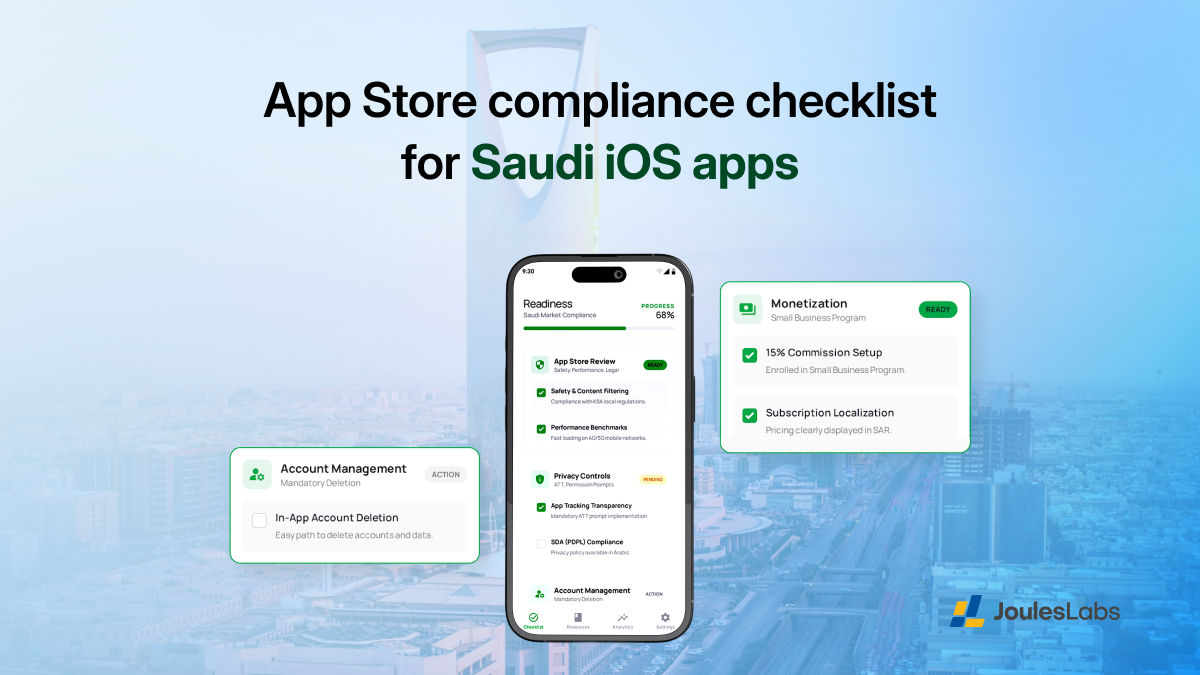
App Store compliance is not a formality; it’s a delivery milestone. Many iOS apps fail review due to avoidable policy misunderstandings.
Apple publishes clear rules, but interpretation and execution matter. Below is a buyer-friendly breakdown aligned with Apple’s primary guidelines.
App Store Review Guidelines Overview
Apple evaluates every iOS application across five core categories. Safety covers harmful content, data protection, and user trust.
Performance focuses on crashes, bugs, broken links, and responsiveness. Business reviews monetization, subscriptions, and payment compliance.
Design evaluates usability, clarity, and adherence to iOS conventions. Legal checks compliance with laws, licenses, and regional regulations.
Saudi apps are reviewed using the same global standards. However, Arabic UX and regional compliance must still be accurate.
Privacy Requirements That Commonly Cause Rejection
Privacy issues are a leading cause of App Store rejection. Permission prompts must clearly explain why data access is needed.
Generic or misleading prompts are frequently flagged by reviewers. A transparent privacy policy must be accessible inside the app.
Tracking requires explicit user consent under App Tracking Transparency rules. Apps must respect denied permissions without blocking core functionality.
Apple’s data-use rules prioritize user choice and transparency. Violations here often delay launches by weeks.
Account Deletion Requirement
Apple enforces strict rules around account lifecycle control. If users can create accounts, deletion must be available in-app.
Redirecting users to email or web forms is not acceptable. The deletion flow must be easy to find and clearly labeled.
This requirement applies to most consumer and subscription apps. Ignoring it almost guarantees App Store rejection.
Subscriptions and Commissions Basics
Apple charges a 30% commission on most digital purchases. Eligible developers can qualify for 15% under the Small Business Program.
Eligibility applies to developers earning under $1 million annually. This directly affects pricing strategy and revenue modeling.
Saudi businesses should factor commissions into unit economics early. Subscription pricing must remain consistent and transparent across markets.
App Store Compliance Checklist
Choosing an iOS app development company in Saudi Arabia
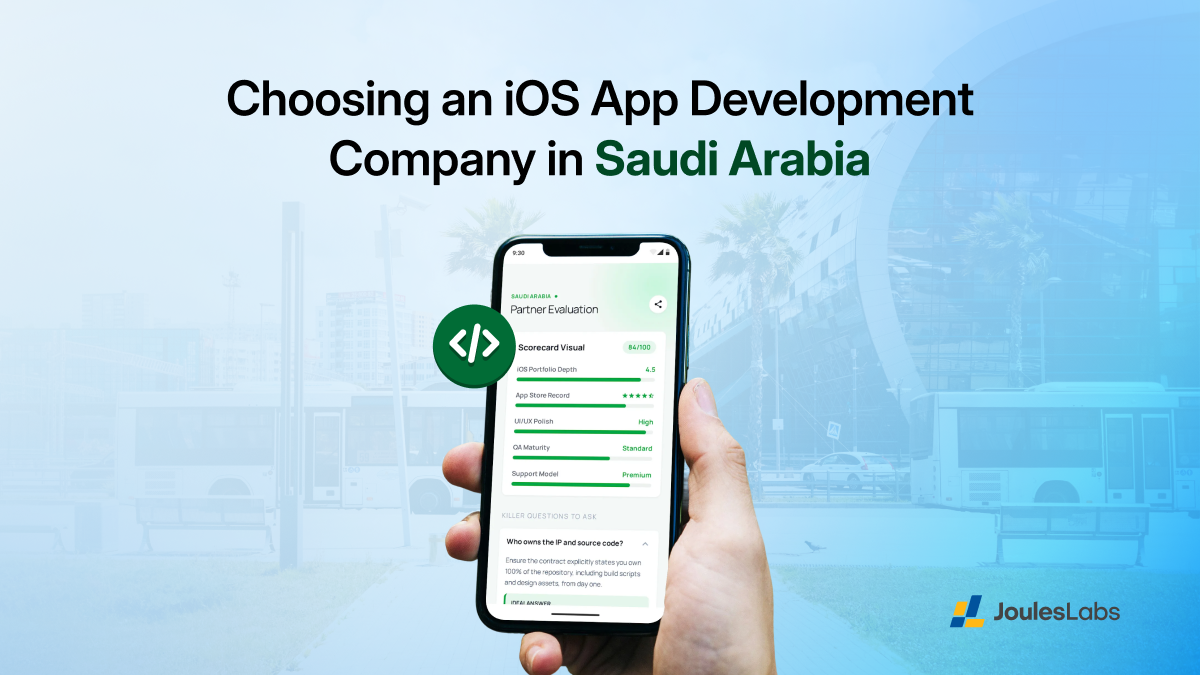
Choosing the right partner is less about price and more about execution confidence. Here’s how to evaluate options without getting lost in sales promises.
What to Look for in a Saudi iOS Partner
Start by checking whether iOS is truly their strength. Many agencies list “mobile apps” broadly, but depth matters.
Look for the following signals:
iOS-specific portfolio:
Case studies should clearly highlight iOS apps, not blended iOS and Android screenshots. Ask what was built natively versus cross-platform.
Proven App Store launch track record:
Shipping successfully through App Store review is a learned skill. Ask how many apps they’ve taken live, not just built.
Strong UI/UX capability:
iOS users expect refined interactions and visual consistency. Good partners talk about polish, not just screens.
QA maturity and device testing strategy:
Professional teams test across multiple iPhones and iOS versions. Crash rates and performance benchmarks should be discussed openly.
Post-launch support model:
iOS updates, bug fixes, and feature iterations are inevitable. Clear support terms signal long-term reliability.
This matters even more when building for Saudi Arabia, where expectations for quality and trust are high.
Questions to Ask Before Signing
Before committing, ask questions that reveal how the team actually works:
- What is your approach to App Store compliance and review risk?
- How do you handle analytics, KPIs, and post-launch iteration?
- Who owns the source code and intellectual property?
- What’s included in maintenance, and what’s billed separately?
Red Flags in Proposals
Some warning signs should slow you down immediately:
- No discovery phase mentioned: This often leads to scope creep and budget overruns.
- Vague QA language: Phrases like “testing included” without detail signal weak quality control.
- No mention of privacy or App Store readiness: Ignoring account deletion, permissions, or privacy policies is risky.
Timelines: How long iOS development takes in Saudi Arabia
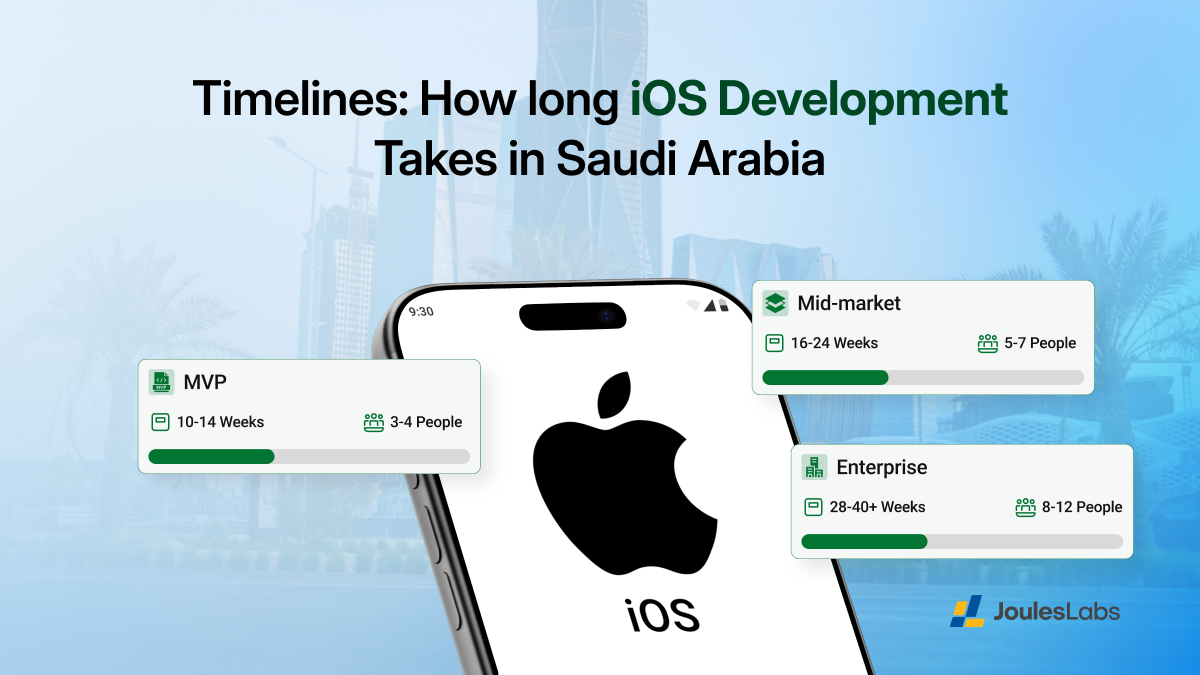
Timelines are one of the first questions Saudi founders ask. Under structured governance, the honest answer is that duration depends strictly on feature complexity, team size, and calculated risk factors
A well-run iOS app development company using the JADEF model plans timelines mathematically rather than conservatively. Most projects fall into three common buckets.
Typical timeline by complexity
- MVP apps usually take 3 to 6 weeks from discovery to App Store release. These focus on core features, limited integrations, and single-platform development (which strictly carries a +0% platform scope risk)
- Mid-market apps typically require 6 to 10 weeks. They include custom UI/UX, admin panels, analytics, and multiple integrations mapped through structured Feature Units
- Enterprise-grade apps often take 21 to 32 weeks. Delivery is extended not by arbitrary “QA depth”, but by Enterprise DevOps infrastructure tiering and maximum capped composite risk adjustments for security and compliance (up to 30%).
What slows iOS projects down
Several issues consistently add weeks to timelines:
- Unclear scope or shifting requirements mid-development
- Late UI or UX decisions after development has started
- Complex third-party or government system integrations
- Multiple App Store review loops due to compliance gaps
What speeds delivery up
Teams that move faster usually do a few things right early:
- Strong discovery workshops with locked MVP scope
- Reusable design systems instead of one-off screens
- CI/CD pipelines and automated testing from the start
- Early App Store compliance planning
Typical Timeline Assumptions
Maintenance and scaling in year 1

Launching your iOS app is only the starting point. In Saudi Arabia, long-term success depends on disciplined maintenance and intentional scaling. High-performing apps treat year one as an optimization and growth phase, not downtime.
What “Maintenance” Really Includes
Maintenance goes far beyond fixing visible bugs. It keeps your app stable, secure, and compatible as iOS evolves.
Key maintenance activities include:
- OS compatibility updates to support new iOS releases and devices
- Bug fixes and performance tuning to reduce crashes and slow screens
- Dependency upgrades for SDKs, libraries, and third-party tools
- Security patching to address new vulnerabilities and threats
- Infrastructure scaling as user traffic and data volumes grow
A Practical Year-1 Roadmap
A simple roadmap helps founders plan effort and budget realistically.
Month 1: Stabilization
Focus on crash reduction, App Store feedback, and performance baselines.
Months 2-3: Analytics-driven UX improvements
Use real usage data to refine flows, screens, and conversion points.
Months 4-6: Retention features
Add push notifications, personalization, and engagement loops.
Months 7-12: Growth and scaling
Optimize infrastructure, introduce new features, and support higher traffic.
FAQs
How much does iOS app development cost in Saudi Arabia?
Most iOS app projects in Saudi Arabia range between $30,000 and $250,000+. The final cost depends on scope, integrations, UX depth, and quality expectations.
Is it better to build iOS first or iOS + Android together?
iOS-first works well for premium, subscription, or enterprise-focused products. Building iOS and Android together increases cost but accelerates broader market reach.
How long does App Store approval take?
Initial App Store reviews usually take 24-72 hours. However, rejections or clarifications can extend timelines by several days.
What causes App Store rejections most often?
Common reasons include privacy issues, unclear permission prompts, and missing account deletion. Performance issues and misleading metadata are also frequent causes.
Do Saudi apps need Arabic and RTL support?
Yes, most consumer-facing apps in Saudi Arabia are expected to support Arabic. Proper RTL layouts significantly improve user trust and adoption.
What’s the annual Apple Developer Program fee?
The standard Apple Developer Program fee is $99 per year. Enterprise programs have higher costs and additional verification.
What is the App Store Small Business Program, and who qualifies?
Apple reduces commission to 15% for eligible developers. Qualification applies to businesses earning under $1 million annually.
Do apps need to provide account deletion?
Yes. If users can create accounts, in-app account deletion is mandatory. This is enforced under Apple App Store policies.
What’s the typical maintenance cost per year?
Maintenance usually costs 15-25% of the original development budget annually.
What should I prepare before contacting an iOS development company in Saudi Arabia?
Have a clear problem statement, target users, rough feature list, and budget range. This helps agencies scope accurately and reduce delivery risk.
Conclusion
iOS app development cost in Saudi Arabia depends on more than features alone. Scope, backend complexity, UX polish, compliance requirements, and QA depth all matter.
Cutting corners usually increases long-term risk and maintenance costs. Your smartest next step is structured, not rushed. Start with a discovery workshop to validate scope and risks.
Define a focused MVP that helps you achieve real business goals. Use a simple vendor scorecard to compare iOS development partners objectively.
Contact JoulesLabs if you need a CTO-level expert for guidance on finding the best dev partner money can buy, no strings attached.